
What is an intervertebral disc?
The discs between the vertebrae act as load-sharing structures in the spine. Each disc has a tough outer layer surrounding a softer central region. Discs change with age, activity and normal wear, and imaging can show a range of shapes and degenerative changes even in people who do not have back pain.
That is why a good assessment looks at the person, not just the picture. A scan can be useful when clinically indicated, but the finding must be interpreted alongside the symptoms and examination
What does “disc bulge” mean?
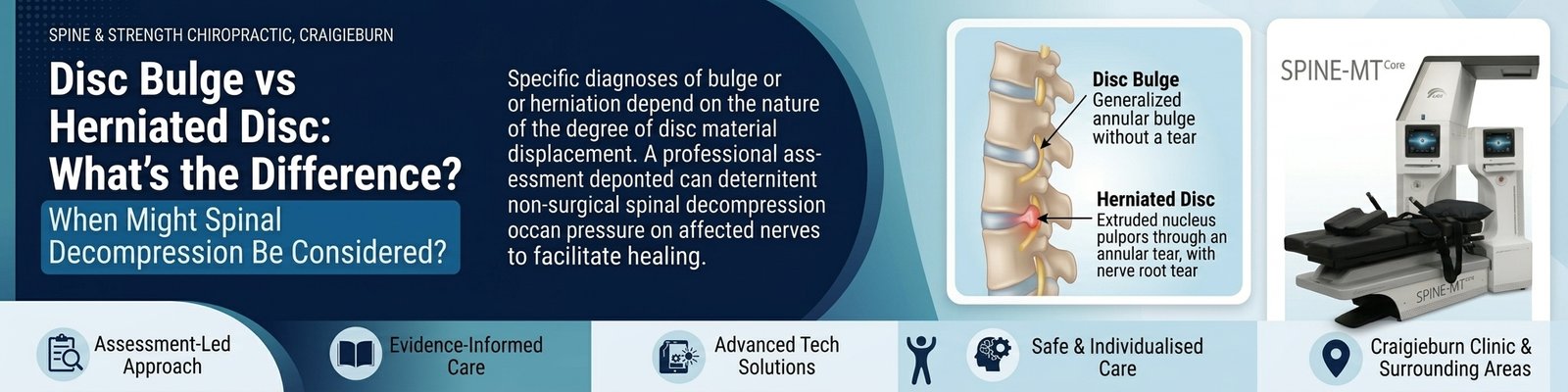
A disc bulge generally describes a broader extension of disc tissue beyond the usual margins of the disc space. It is a description of shape rather than a diagnosis of pain. A bulge may be present at one or more levels and may or may not irritate nearby structures.
Importantly, disc bulges are also seen in many people without symptoms. If your report says “disc bulge”, the next question should not be “How bad is it?” but rather “Does this finding fit with what I am experiencing?”
What is a herniated disc?
A disc herniation is a more focal displacement of disc material. Radiology reports may use terms such as protrusion or extrusion to describe the shape and extent. A herniation can sometimes affect a nearby nerve root and contribute to symptoms such as leg pain, tingling, altered sensation or weakness. In other cases, it may be present without significant symptoms.
Disc bulge vs herniated disc: the practical difference
| Question | Disc bulge | Disc herniation |
|---|---|---|
| What does the term describe? | A broader extension of the disc contour. | A more focal displacement of disc material, sometimes described as protrusion or extrusion. |
| Does it always cause pain? | No. Bulges can be present without symptoms. | No. A herniation can be symptomatic or incidental. |
| What matters clinically? | Whether the finding matches symptoms, examination and function. |
Whether the finding matches symptoms, neurological signs and function. |
What symptoms can a disc-related problem produce?
Disc-related presentations vary considerably. Some people mainly notice local back pain orstiffness. Others experience symptoms that travel into the buttock or leg. Depending on the structures involved, symptoms may include:
- Lower back pain that is persistent or repeatedly returns.
- Pain that travels into the buttock, thigh, calf or foot.
- Tingling, pins and needles or altered sensation.
- Pain that changes with sitting, bending, lifting, coughing or certain movements.
- A feeling of weakness or reduced confidence using the leg
- Difficulty sleeping, working, driving or exercising comfortably.
These symptoms are not specific to one diagnosis. Similar symptoms can come from differentspinal, joint, nerve or soft-tissue problems, which is why self-diagnosing from a scan or an onlinesymptom list can be misleading.
Does an MRI finding always explain the pain?
No. Research has repeatedly shown that degenerative disc findings can appear on imaging in people who have no back pain at all. Imaging can still be clinically valuable, but it is most useful when interpreted in context rather than treated as a stand-alone answer. At Spine & Strength Chiropractic in Craigieburn, the assessment process is designed to connect the history, symptoms, movement findings and neurological signs with any existing imaging. If further investigation is clinically indicated, this can be discussed as part of the next-step plan.
How are disc-related symptoms assessed?
A structured assessment may include questions about how the symptoms started, where the pain travels, what positions aggravate or ease it, previous injuries or procedures, current medications and the effect on work, sleep and activity. The physical examination may include spinal and joint movement, functional movement, strength, sensation, reflexes or other neurological screening where relevant.
The purpose is not to force every patient into the same treatment. It is to determine what appears to be contributing to the problem, whether conservative care is appropriate and whether another health professional or further investigation should be involved.
Who may not be suitable?
Non-surgical spinal decompression uses controlled mechanical loading and unloading of the spine. In selected patients, a clinician may discuss it as one part of conservative care for a disc-related or nerve-related presentation. The available research on traction-based approaches suggests possible benefits for pain and disability in lumbar disc herniation, but results vary across studies and treatment methods, so it should not be presented as a guaranteed solution.
At Spine & Strength, the decision to use spinal decompression should follow a suitability assessment. Factors such as your symptoms, examination findings, medical history, previous surgery, bone health and other health conditions can influence whether it is appropriate. Where it is used, it may sit alongside movement advice, clinical rehabilitation, chiropractic care or other strategies rather than replacing them.
A scan label does not automatically determine treatment. The best next step is to understand whether the imaging finding is relevant to your symptoms and whether conservative care is appropriate for you.
When should back or leg symptoms be assessed urgently?
Most back pain is not a medical emergency. However, urgent medical assessment is appropriate if back or leg symptoms are accompanied by new bladder or bowel control problems, numbness around the groin or saddle area, rapidly worsening weakness, loss of movement or sensation, significant trauma, fever with severe back pain, or other rapidly worsening symptoms.
Frequently asked questions
Can a disc bulge exist without pain?
Yes. Disc bulges and other degenerative findings are common on imaging, including in people without back pain. Whether a finding is clinically important depends on how well it matches the symptoms and examination.
Is spinal decompression the same as surgery?
No. Non-surgical spinal decompression is a conservative mechanical therapy. Surgical decompression is a different medical procedure. The word “decompression” can therefore mean different things depending on the context.
Do I need an MRI before spinal decompression?
Not every person requires imaging. Existing scans may be useful, and further imaging may be recommended when the clinical history or examination indicates that it would help guide care or rule out another problem.
How many spinal decompression sessions will I need?
There is no responsible single number that applies to everyone. If decompression is considered appropriate, the proposed frequency, review points, expected benefits, limitations and alternatives should be discussed with you before care begins.

A clearer next step for disc-related back pain
If you have persistent back pain, a disc-related scan finding or symptoms travelling into the leg, the first goal is to understand what the symptoms are likely to represent. A professional assessment can help determine whether spinal decompression, another conservative approach, further investigation or referral is the most appropriate next step.
Spine & Strength Chiropractic provides spinal decompression and broader musculoskeletal care from its Craigieburn clinic. If you would like your symptoms and existing scans assessed, you can book an appointment online or call 03 7302 1240.
General information only. This article does not replace individual medical advice, diagnosis or emergency care.
